Understanding Usability
When it came to usability it’s interesting to see how sites evolve. Using the Internet Wayback Machine (Wayback Machine, n.d.) I found it very interesting to see how sites evolve over time. Seeing previous verisions of previous sites dated many years back I found very useful as a way to analyze not only a company you work for but also competing companies. In the class we looked at three historical versions of CNNSI.com (now SI.com) and how it has changed. We explored the years of the site in: August 15, 2000, September 1, 2004 and today. There were many things that changed over time from: color, logo, tagline, adding search bar, newspaper style to more modern, and a transition to a cleaner more simplified look. What did not change is the messaging.
What I learned from the usability section of the course is that viewing historic versions of any sites usability can give you insights to further improve the user experience. After doing the assignment, I took an inititave to look into the company I work for and it was quite interesting. Seeing the older versions helps me to understand how the company has changed over time. It also allows me to see the marketing focus on the site over time as the banners change. I think this is a very useful tool I plan to use a lot.
Diving deeper into usability, I took a look into my chosen case study company, Kelston Marketing, doing a homepage analysis. Through this excercise I realized elements Kelston needs to change such as text that looks like a clickable link but actually leads to nowhere. I dug into each link in the homepage and did a competitor analysis. The importance of usability honestly seems crucial to any company. I can see the crucial part of usability now and how it can impact findability, it is not just SEO.
Citations:
-Wayback machine. (n.d.). https://web.archive.org/
-Sports Illustrated. (n.d.). SI. https://www.si.com/
Usability Testing
When it came to usability testing this was a newer exercise for me. Getting three participants to interact with the content that Kelston has really set a perspective on how easy/hard it was for people to use the site. This exercise has me looking into tasks for users to complete then presenting them with the task and no information. Their job was to complete the tasks and provide feedback.
This exercise is something I can definitely see myself implementing in the future to get better feedback on the sites navigation itself. Seeing how participants interact with different objects themselves is very useful and I could see how this could definitely be useful for A/B testing. The biggest thing I learned about usability is the value testing has to better understanding navigation. If the end customer is in a certain demographic it is valuable to do usability testing in that way as well. Very valuable!
Findability
Navigation is such crucial to findability. It is not just any SEO anymore. Findability is a team effort and this class allowed me to understand how each individual element can play a role in findability. An example is even if a consumer finds your website if they cannot find the services they may leave the page. Seeing the different views: desktop, minimized tab and desktop each played a part as well.
Depending what type of screen you are in can depend on how users interact with the content. Also page order is important such as how a scrolled page is arranged, which navigation links are in which order and if it changes based on the view. This class really allowed me to dig in.
Synthesizing Usability Data Into Information
Taking data and tuning it into actionable insights was the last key to the puzzle, It was very clear how the use of Google Data Analytics, SEO analytics and heat maps can be so valuable to informational insights. Looking at strengths/weaknesses of the case study company and creating personalized recommendations is something that will definitely be of use to me later on in my career. The value this class has had cannot be undervalued there was tons of insights that I hope to bring to my professional career.
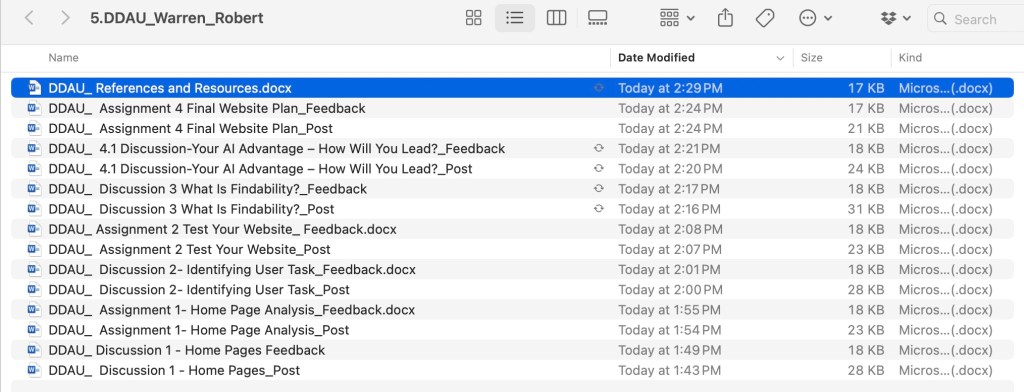
Sharepoint Organization
This is a screenshot showing the information of the class being organized into folders for reference in the final project.
Initial goals for reference:
Overarching:
“Overarching Career Goal (Long Term Goal): My career goal is to lead a team in social media management, through creatives, paid and organic strategies, driving engagement, making meaningful conversations, and driving purpose to an audience. I am seeking to find my place in a successful salary long-term career in the digital marketing field where I can bring value, create a difference and make meaningful data-driven measurable results for a company, or agency. I am not looking for just a job. I am looking for a career. One of the keys to achieving this is staying motivated. According to the 2022 academic study ‘How and when goal-oriented self-regulation improves college students’ well-being: A weekly diary study,’ by Wang, Yang, and Li, ‘Results showed that the indirect effect of goal-oriented self-regulation behaviors on psychological well-being through academic performance is stronger when college students are more optimistic and gain more social support.’ (Wang, Yang, Li, 2022)”
Upon Graduation
“Goal to accomplish upon graduation: When I graduate Full Sail University my goal is to be strongly connected with my peers and instructors, be well rounded in digital marketing, from organic to paid, have a portfolio to show, understand the concepts confidently and be able to have a career lined up for the start of my future. I am seeking a salary position in an agency when I can learn more, have strong contributions, growth opportunities, offer knowledge exchanges with my peers, and be a part of a company I enjoy working for. My goal is to land this career in either the paid or organic sector but upon graduation have this lined up.”
Timeline:
“Deconstructed Steps to accomplish these goals:
-MONTH 1: By the end of the first class, I put together a brainstorming framework with some analysis of the digital marketing field. At the end of this class, I want to make sure to get this put on my mastery journal, along with my research essay that showcases Gary Vaynerchuk, a true inspiration to the field. Having these two items on my mastery journal can inspire me and push me in the right direction. I also created two dream boards as part of one of my goals for this class and I want to make sure to take images of these then put them on my mastery journal as well for continued reflections
-EVERY MONTH: At the end of every class I take throughout the semesters I want to try to connect individually with each of my professors on LinkedIn, along with connect with several of my peers on LinkedIn.
-MONTH 2: By my the end of my second class I am planning to have a portfolio that showcases the elements of social media that I can offer clients when working for a company.
-MONTH 3: By the end of my third class I want to see if there is any opportunities with some of Full Sail’s social media, and become more familiar with Career Development on Full Sail One.
-MONTH 6: By my halfway point, at the start of Month 6, I want to make sure that I deeply understand the agencies that are near me that I might be able to work for, along with this I want to have put together a list of the agencies that I may be considering upon graduation.
-MONTH 7: At the start of Month 7: I may want to start putting in some applications for internships (based on length, pay and bio) and agencies. Such places can include Sabre, (Southlake,) Hearts & Science, (Dallas,) PMG (Dallas,) Dropbox (Remote,) and more.
-MONTH 8: At the start of Month 8: I want to try to follow up on some of these internships and if I do not hear back, apply for some more then reach out to them. I will continue to do this through Month 9.
-MONTH 9: On Month 9 I want to make sure that I understand paid social media marketing deeply.
-MONTH 10: At the start of Month 10: Re-evaluate my resume, portfolio, mastery journal, and internship opportunities
-MONTH 11: Month 11 from the get-go: re-access my situation, relook at my internship situation and complete any tasks that need to be done to secure that or a job in the field
-MONTH 12: Month 12: Reflect on Robert Greene`s book Mastery. (Greene, 2013) Look for a career in the field.
-GRADUATION: Fly to Florida to walk the stage. Secure the job. Next steps.
-POST GRAD: By one year after graduating I want to aim to move to Southlake, Texas. This would be ideal is a center point from Dallas, Fort Worth, Denton, Frisco and Arlington. This would make it much easier to aim for jobs in many different cities and provide a nice atmosphere of living. Within two years of graduating have my dream career. Make sure to thank whoever helped me get there, write thank you notes and send to them. (Either digitally or through the mail.)
Smart Goals Reminder:
SMART, MEASURABLE, ACHIEVABLE, RELEVANT, TIMEBOUND”
Citations:
Wang, H., Yang, J., & Li, P. (2022). How and when goal-oriented self-regulation improves college students’ well-being: A weekly diary study. Current Psychology, 41(11), 7532–7543. https://doi.org/10.1007/s12144-020-01288-w. Referenced from EBSCO HOST.
Greene, Robert. Mastery. Penguin Publishing Group. Kindle Edition.
“The brick walls are there to give us a chance to show how badly we want something.” – Randy Pausch
 Social Marketing With Rob
Leave a comment